Frederick, MD
Boxelder Bug Control in Frederick, MD
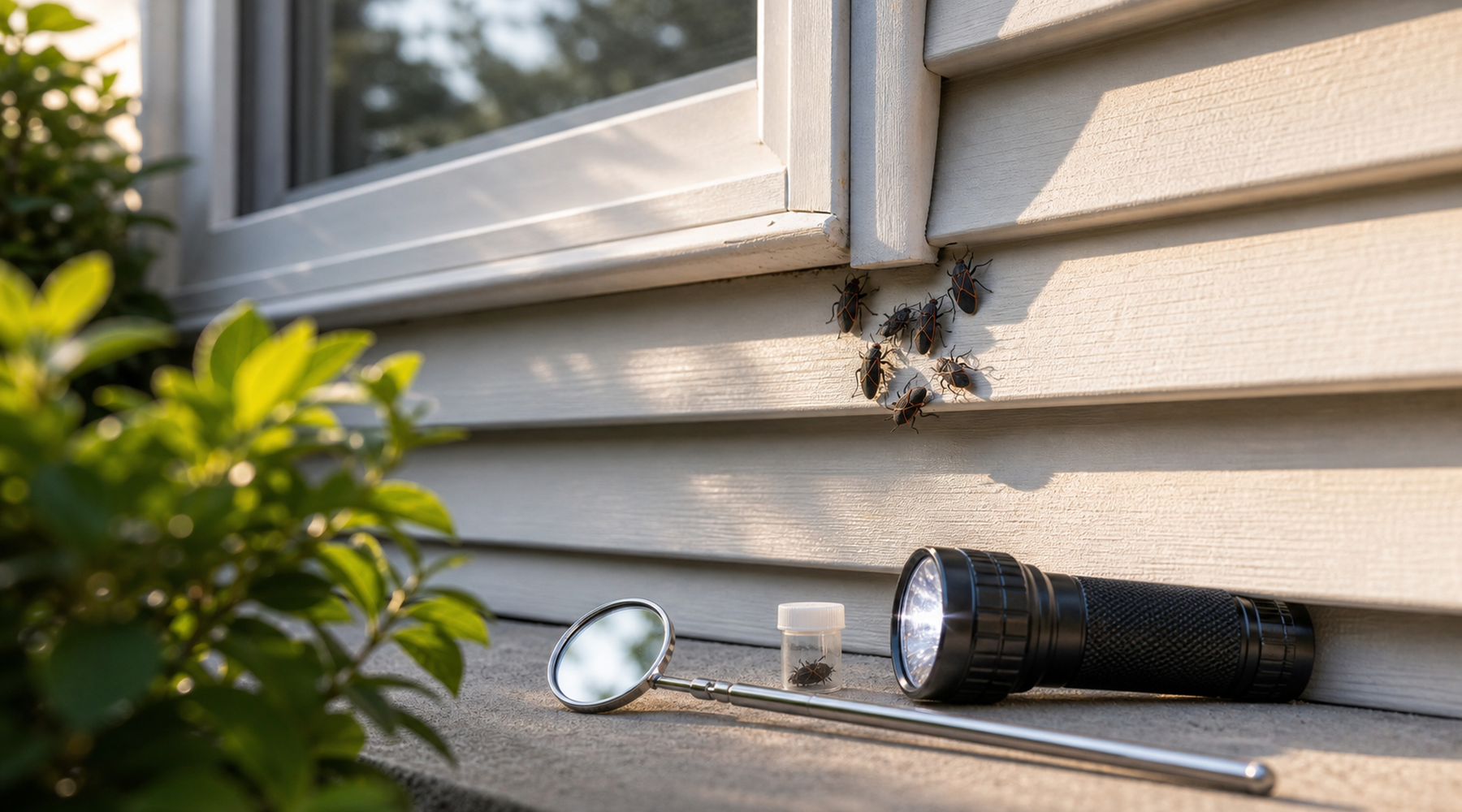
Boxelder bugs (Boisea trivittata) aggregate on south and west-facing walls in large numbers each fall, seeking overwintering gaps in Frederick structures. Perimeter treatment and exclusion caulking before October is the most effective approach.
Same Infiltration Timing as Stink Bugs
Boxelder bugs follow the same fall photoperiod and temperature cues as brown marmorated stink bugs — they aggregate on warm, sun-exposed wall surfaces in September and October and seek gaps to overwinter inside structures. Properties near boxelder, maple, or ash trees face the highest boxelder bug pressure each fall.
Exterior Treatment Before Aggregation
Residual insecticide applied to south and west-facing foundation walls, window frames, and wall surfaces in late September creates a contact-kill zone for aggregating boxelder bugs before they locate and exploit entry gaps. Treatment before the aggregation peak is more effective than treatment after bugs are on the wall in large numbers.
Host Trees Determine Risk Level
Boxelder bugs feed on boxelder (Acer negundo) seeds during summer. Properties with boxelder trees, female silver maples, or ash trees nearby have significantly higher fall population pressure than properties without these host trees. Tree proximity is the primary predictor of whether a Frederick property will have heavy or light boxelder bug activity each fall.
Boxelder Bugs in Frederick: The Fall Infiltration Pattern
Boxelder bugs are a nuisance pest rather than a destructive one — they do not bite, sting, damage wood, contaminate food, or reproduce inside structures. Their impact is entirely cosmetic and psychological: the sight of hundreds of black-and-red insects aggregating on an exterior wall, and the subsequent appearance of individuals inside the home as overwintering bugs become active on warm winter or spring days. The control strategy is entirely oriented toward preventing that infiltration in the first place, because once boxelder bugs are inside wall voids and attic spaces, removal options are limited to vacuuming emerging individuals as they appear.
Boxelder Bug Biology: Why They Come to Your House
Boxelder bugs (Boisea trivittata) are true bugs (Hemiptera) — flattened, oval-shaped, approximately 1/2 inch long, black with red markings on the wing margins and thorax. They feed on the seeds of boxelder, maple, and ash trees during spring and summer and are rarely noticed until population buildup is complete in late summer. In September, as day length shortens and temperatures drop, they begin moving from host trees toward south and west-facing structures — the warmest, most sun-exposed surfaces available — where they aggregate in large numbers and probe for gaps to enter for overwintering.
Inside the structure, they overwinter in a quiescent state in wall cavities, attic spaces, and any undisturbed interior zone. On warm winter days and during the spring warm-up in March and April, they become active and move toward light — appearing on window sills, ceiling fixtures, and interior walls. They do not feed inside structures and do not reproduce indoors. The entire lifecycle of the spring and summer generation is tied to outdoor host tree seed production — indoor appearance is entirely an overwintering behavior, not a breeding event.
Properties adjacent to boxelder trees — a common ornamental and naturalized tree in Frederick County — have the most consistent annual boxelder bug pressure. If the host tree is on your property or a neighbor's property within 100 feet of your south-facing wall, you will likely have annual fall aggregation activity regardless of whether your structure has any particular gap condition that other properties lack.
Distinguishing Boxelder Bugs from Stink Bugs
Both boxelder bugs and brown marmorated stink bugs aggregate on Frederick homes in fall and seek overwintering entry gaps. They differ in appearance and slightly in timing: boxelder bugs are flatter, more elongated, and distinctly black-and-red; stink bugs are shield-shaped, mottled brown, and slightly larger. Both respond to the same control approach: perimeter treatment on south and west-facing walls before the October aggregation peak, combined with gap caulking at window frames and utility penetrations. Properties with both species — common in Frederick's suburban neighborhoods — can address both with the same fall exclusion and treatment program without separate service visits for each species.
Interior Management When Bugs Are Already Inside
Boxelder bugs that have already overwintered inside the wall cavity or attic will emerge in spring as interior temperatures rise. The appropriate interior management: vacuum emerging individuals as they appear — do not crush them against light-colored surfaces, as they can leave a faint red-orange stain. Do not apply insecticide sprays inside the living space for boxelder bugs — this is not effective for bugs dispersed through a wall void and will leave unnecessary chemical residue in living areas. The spring emergence decreases over four to six weeks as the overwintered population exhausts itself. After spring emergence concludes, completing the exterior exclusion work for the following fall is the priority action.
How Boxelder Bug Control Works
Exterior Inspection
Inspect south and west-facing walls for boxelder bug aggregation sites, entry gaps at window frames, door frames, and utility penetrations. Assess proximity and species of host trees.
Gap Caulking
Caulk at window frame gaps, door frame gaps, and utility penetrations on south and west-facing walls where boxelder bug entry is most likely. Combined with stink bug exclusion work when both species are present.
Perimeter Residual Treatment
Residual insecticide applied to foundation wall, lower wall surfaces, and window and door frames on sun-exposed sides of the structure. Timed to late September before aggregation peaks in early October.
Interior Management Guidance
For properties with existing interior presence: vacuum removal protocol, spring emergence management guidance, and staining risk awareness for preventing surface damage from crushed bugs.
Seeing Boxelder Bugs Aggregating at Your Frederick Home?
Call (240) 555-0157 or contact us online. September treatment before the October peak significantly reduces interior infiltration. Schedule before the aggregation window begins for best results.
Request ServiceBoxelder Bug Questions
Do boxelder bugs bite or cause any damage?
Boxelder bugs do not bite and are not known to transmit any disease. They do not damage wood, fabric, food, or structural components of a home. The cosmetic concerns are: the visual impact of large aggregations on exterior walls; occasional staining on light-colored window frames or upholstery from the orange fluid they can release when crushed or stressed; and the nuisance of individual bugs appearing on interior window sills and walls during spring emergence. From a practical standpoint, boxelder bug problems are almost entirely a quality-of-life issue rather than a structural or health issue — but that does not make the sight of 200 insects on your south wall in October any less disruptive.
Will removing boxelder trees from my property eliminate the problem?
Removing boxelder trees from your immediate property will reduce the local population that develops on those specific trees each summer. However, boxelder bugs can fly several hundred feet from host trees to find overwintering structures — a neighbor's boxelder tree 50 feet away will still contribute to fall aggregation at your structure. Tree removal is a significant decision and a slow-return investment for boxelder bug management alone. The more practical approach is perimeter treatment and exclusion each fall, which costs far less than tree removal and addresses the immediate infiltration problem. If a boxelder tree on your own property is in poor condition and needs removal for other reasons, that is a reasonable combined benefit — but it is not a pest control recommendation we make for boxelder bug management alone.
Can I use a pressure washer to knock boxelder bugs off the wall?
A pressure washer will remove boxelder bugs from the wall surface in the short term, but it does not deter them from returning — and it does nothing to prevent the ones that have already entered through gaps. It is a useful step to reduce the number of bugs on the wall immediately before an exterior treatment is applied, because treating a wall with fewer bugs present means less residue on bug surfaces and more residue available for bugs that land after treatment. If you choose to wash the wall first, do so at least 30-60 minutes before we arrive so the surface has a chance to dry before treatment application. A wet wall significantly reduces the adhesion and residual life of any water-based insecticide formulation.
Related Services
Stink Bug Control
Stink bugs and boxelder bugs share the same fall infiltration window — exclusion caulking and perimeter treatment for both is scheduled as a single fall service in Frederick.
Preventive Pest Service
Comprehensive fall exclusion for Frederick homes — the caulking and gap sealing that reduces both boxelder bug and stink bug infiltration each October.
Attic Pest Control
Attic inspection for overwintering boxelder bug and stink bug populations in Frederick homes — the source of spring emergence into living areas.